Sunday, February 16, 2025

Trump versus Biden on Jobs

Trump versus Biden on Jobs

To compare jobs in the economy during the Trump years of 2017 to 2021 with the Biden years of 2021 to 2025 requires allowing for the job losses from the Pandemic quarantine, which recall started in the early spring of 2020. In the jobs data for March 2020 establishment employment reached 150.898 million jobs. A month later in April 2020 establishment employment declined to only 130.421 million jobs, a decline of 20.477 million jobs.

Both presidents were in office for 48 months, the usual four year term. In the first 39 pre-Pandemic months of Trump’s first term in office, establishment employment increased by 5.262 million jobs. The Pandemic job decline of April 2020 and slow job recovery restored the Pandemic job losses by February 2022, the thirteenth month into the Biden Administration. While many continued to wear face masks and be wary of spreading Covid, the pharmaceutical industry had a vaccine available and jobs had returned to their pre-Pandemic total and a semblance of normality. This leaves the last 35 months of the Biden administration as a normal and comparable period for review with the first 39 months of the Trump administration.

In the first 13 months of the Biden Administration jobs increased just under 7.960 million to 150.876 million jobs, which restored the remaining Pandemic job losses left from the Trump term. In the last 35 months of the Biden administration beginning with February 2022, national employment increased by 8.660 million jobs. Therefore, the Trump economy that generated 5.262 million new jobs during the 39 months the pre-Pandemic months did not do as well creating jobs as the post Pandemic Biden economy that generated 8.660 million jobs in 35 months.

The Biden administration’s superior performance on jobs resulted primarily from a selection of industries where the Biden economy did much better.

Health Care and Education

Start with health care where Trump created 1.326 million health care jobs in 39 months while the Biden economy created 2.691 million jobs in 35 months. Move to education where the Trump economy created 90 thousand jobs in private education, while the Biden administration created 256 thousand jobs. In state supported public education the Trump economy created 84 thousand jobs while the Biden economy created 192 thousand jobs. In the local public schools the Trump economy created 130 thousand new jobs where the Biden economy created 457 thousand new jobs.

Leisure and Hospitality

Leisure and hospitality did much better during the Biden Administration and in all its sub sectors: performing arts, spectator sports, museums, historical sites, amusements, gambling, recreation, accommodations, restaurants and related food services. The combined changes were 284 thousand more jobs for Trump in 39 months while the Biden economy added 1.527 million jobs in the last 35 months of his administration.

Government

In government employment, excluding education, Biden and the Biden economy created more jobs and did so in all three levels of government: federal, state and local. The first 39 months of the Trump administration brought a combined increase of 313 thousand government jobs, with 80 thousand of those jobs in the federal government, not counting the post office. Under Biden the total increase was 879 thousand.

Trade, Transportation and Utility

Retail trade employment during the first 39 months of the pre-Pandemic Trump economy dropped 440 thousand jobs, but more jobs in the courier and messenger sub sector Trumps pre-Pandemic economy created 216 thousand new jobs. The result undoubtedly reflects the general decline of sales at the cashiers check out in exchange for home delivery of Internet sales. The combined increase of courier and messenger jobs and 366 thousand new jobs supporting home delivery in the warehouse and storage sub sector during the first 39 months of the Trump administration were large but not as large as a recovery of trade jobs, modal transportation and utility employment during the Biden economy. The combined trade, transportation, and utility sector, a.k.a. NAICS 40, had 345 thousand new jobs during the pre-Pandemic Trump years but 465 thousand new jobs during the post Pandemic Biden economy.

In those sub sector industries where remote work is possible Pandemic job losses were small and quick to recover. These were primarily in finance and banking, and the professions such as law, accounting, computing, engineering and various management consulting and research industries. Job gains in these sub sectors were comparable for Trump and Biden as, for example, in management and technical consulting services where there were 164 thousand new jobs during the 39 pre-Pandemic months of the Trump administration, but 142 thousand new jobs during the 35 post-Pandemic months of the Biden administration. The Trump economy did somewhat better in goods production – natural resources, construction manufacturing - in the pre-Pandemic period than the Biden economy in the post-Pandemic period: Trump 1.082 million jobs, Biden 811 thousand jobs.  It should be mentioned that goods production was 21.96 percent of establishment production in 1990 that has declined continuously to 13.58 percent by 2025, a decline of 8.38 percent in a decline that shows no sign of ending.

The superior job performance during the Biden economy came in part because of much higher job growth, but especially in the jobs of the future. New jobs will have to come in health care and education as they have been. Otherwise, replacement jobs for the millions of manufacturing jobs corporate America has moved abroad have been coming in leisure and hospitality and government service and will have to continue given remaining service industries continue to grow so slowly they have a declining share of national employment.

During his first term Trump liked to brag about the new jobs on the Bureau of Labor Statistics monthly jobs report and take credit for creating them. As his second term gets under way, he appears determined to enlarge the unemployed as fast as he can. For the new unemployed among us beware of ventilating politicians and union officials advising obedience to the “law.” Try hard to understand the significance of January 6.

Tuesday, January 14, 2025

The Vice President’s Job

The Vice President’s Job

Amendment Twelve of our U.S. Constitution defines the Vice Presidential office to be a person waiting to succeed as president, but for one reason: death of the President. We can excuse the founding fathers for wanting someone a heart beat away, as the saying goes, to become president given the primitive state of medicine and the opportunities for death in 1787. Still designating the next president in advance unmistakably resembles monarchy, or royal succession, not democracy. The founding fathers had nothing for their V-P to do, just like a British Prince, and so gave him, and lately her, a vote in the Senate in the event of a tie. As the office remains in 2025, the vice president gets a salary of $250,000 for a job that neither requires, nor allows, work defined in the Constitution.

From 1837 when Vice President Martin Van Buren succeeded Andrew Jackson until 1989 when Vice President George H.W. Bush succeeded Ronald Reagan, no vice president succeeded a president by election. Death, assassination and one resignation have given us six accidental presidents since 1877 that include Chester Arthur, Theodore Roosevelt, Calvin Coolidge, Harry Truman, Lyndon Johnson, and Gerald Ford. These six men, like all ambitious politicians, had to confront the reality that party bosses choose vice presidential candidates to "balance the ticket" as an aide to electing someone else. Once installed as vice president, they typically get assigned some empty task the President defines for them and then get shoved aside. They seldom give sign of independence and refuse to say anything controversial for fear of offending their President and jeopardizing a faint and evanescent hope of presidential office or a political career. Vice Presidents do too much of what they are told: Mike Pence to wit.

The vice-presidential office should be abolished. If we are a democracy we should prefer voting for all our presidents, but we should also make the best of what Amendment Twelve defines.  Our vice presidents have a unique place in American politics precisely because he or she lives a heart beat away and can become the president in an instant. That threat makes them hard to ignore if they do not choose to be ignored. Since they have no boss or defined political power and little or no future as a politician, they can and should get the attention they need to aggressively confront controversial matters suppressed or ignored by corporate America and the politicians they own and control. Democrats take note.


Saturday, January 11, 2025

The Back to the Office Movement of 2025

The Back to the Office Movement of 2025

The motive for the Back to the Office movement touted by Trump and the Republicans comes to us as a legacy of slavery. Recall slaves worked as farm labor, domestic servants and gradually some of them as craftsmen trained by their owners to exploit as contract labor. Historian Ron Cherno reports George Washington hired out his surplus slaves.

The slaves of 1787 to 1860 made up a significant minority of the population in a country of small farmers, independent tradesmen but minimal manufacturing limited to textiles and some iron smelting. Before 1860 slaves were the working class given the white population primarily earned a living as farmers or self-employed entrepreneurs. Southern plantation owners needed a mass labor force to harvest cotton and tobacco, which concentrated employment among a limited number of wealthy employers. Where the modern corporation hires the working class for wages, the antebellum plantation owner had working class slaves paid-in-kind.

Recall slaves worked and lived under arbitrary rule in a system of forced labor; resistance brought immediate reprisal as physical abuse and corporal punishment from colonial times. These habits of arbitrary rule over slave labor have made it easy for America’s capitalists to expect obedience for the hired help long after slavery ended. It can be no surprise the south provides the greatest resistance to job rights and union organizing. The lingering effect of more than a century of arbitrary rule during slavery make it easy for contemporary capitalists to expect they have arbitrary authority over today’s employment and the right to devise various types of reprisals against working class demands for a measure of respect and the job rights to go with it. Slavery lives in the employer expectations of today.

The Back to the Office movement comes to us as an especially petty example of corporate contempt and class war politics. Recall how Wisconsin Governor Scott Walker had an easy time getting the angry working class to support his attack on school teachers as a lazy and overpaid group deserving wage cuts and union busting. Now we see how  Trump has an easy time getting his angry and contemptuous base to support the hardship and expense back to the office creates for government employees. The politics of contempt.

Since managers and supervisors have had laptop computers and the Internet to pressure employees to be available at home in the evening and on weekends for many years, the suggestion they must be at “work” 9 to 5 on weekdays appears especially idiotic. Commuting imposes financial costs on employees and also the time and energy squandered getting “there” that cannot be defended as good for productivity or profits. Never assume as economists like to do that corporate America wants to maximize profits; divided social classes generate inequality as a perk of the upper class.

America’s corporate autocrats have always known the arbitrary, abusive and demeaning use of authority directed down through a hierarchy to the farm fields, the shop floor, the cashiers check out, or the secretary’s desk brings anger and resistance from some, but fear and hesitation from others. Corporate America promotes these internal divisions when they look the other way and encourage or ignore the abuses of supervisors and managers. The more assertive will fight the abuses, while the timid and cowardly withdrawal or adopt the stance of their authoritarian employers. The historical record of union busting documents the deliberate use of intimidation and verbal deceit for dividing the working class.

Sowing division among the working class through dissension on the job has worked well as a continuous disruptive force in opposition to the working class and their political and economic solidarity. Journalist and author William Allen White wrote of the Republicans of the 1920’s era as “shocked to tears at anything that tore apart the identity of wealth with brains.” Such a view follows from an upper class hope for an acceptable justification for their wealth. Contrast that with today’s wealthy and well placed that delight in showing their contempt for the working class with a political campaign that includes Back to the Office.


Tuesday, December 31, 2024

Ludlow, Colorado

Ludlow, Colorado

I recently visited Ludlow, Colorado, the site of the violent coal mining strike of 1913-1914, which I believe had more violence and misconduct by government officials than any other strike in labor history; violence in addition to the usual violence of corporate management. No one lives there now and the buildings of the period are gone, although some rubble remains. For those like me who have studied what happened there it felt important to see the site and be physically oriented having previously seen only archival maps and pictures. For those familiar with this history I hope the pictures below may help orient you as they have for me. 


Picture 1 - The sign on County Road 44 about 13 miles north of Trinidad, Colorado and about a mile west of Interstate 27


 Picture 2 – The Ludlow Memorial that has the inscription “In Memory of the Men, Women and Children who lost their lives in Freedom’s Cause at Ludlow, Colorado April 20, 1914. Erected by the United Mine Workers of America.” It sits at the corner of the Ludlow Tent Colony and one of the underground pits remains just in front of the Memorial.


Picture 3 – The right side of the memorial has a plaque that designates the Ludlow Tent Colony site as a National Historic Landmark. It reads this site possesses national historical significance in illustrating the history of the United States of America. The plaque was placed on the monument in 2009 by the National Park Service, although the site is part of land purchased by the UMW in 1917.


 Picture 4 – The present railroad looking south from County Road 44 as it intersects with County Road 61.5. The railroad that went through Ludlow in 1914 was known as the Colorado and Southern. What remains today sits on the same right of way as part of the Burlington Northern-Santa Fe Railroad. Sidings and a passing track are gone. To the left of the tracks in the picture there was the depot, a Post Office, a saloon and a few other residences and stores, which are obviously gone. Across from the memorial and former tent colony is the site of a baseball field used by the striking miners and families. In the distance to the south a slight rise is the site of a former public water tank known as water tank hill where Militia machine gunned the camp.


Picture 5 - The present railroad looking north from County Road 44 as it intersects with County Road 61.5. To the right of the tracks there was railroad well and water tank, essential for locomotives in the steam era of 1913-1914. There was a house and barn as well, but all are gone now. A small distance farther down the track comes to a deep gully, or arroyo that remains. It was a place of defense and refuge during the day long attack.


Picture 6 – Is a picture of County Road 44 at a point in the Canyons east of Ludlow that have the remains of the Hastings and Delagua mines. The rail lines that served these mines are gone. The mines no longer operate and the valley areas have become grazing land for cattle ranching. Every arroyo crossing has a cattle guard.


Picture 7 – Nearby Trinidad, Colorado played a violent role in the Ludlow strike as the headquarters of National Guard troops, the Los Animas County sheriff and his deputies, managers of the coal mines, and the Baldwin-Felts mine guards.  The picture shows the S. Commercial Street of 2024 going up hill from where the train depot and tracks of the Colorado and Southern Railroad were in 1913-1914. The tracks remain as part of the BN-SF Railroad and even though the depot is long gone the Southwest Chief stops in Trinidad as part of Amtrak’s western routes. Interstate 27 runs on stilts to the right of the tracks.


 Picture 8 – Further up S. Commercial Street the Toltec Hotel remains looking much like it did in the pictures of 1913 when Colorado Deputy Labor Commissioner, Edwin Brake, got off a train to walk up the hill from the depot to the Toltec Hotel. As he approached shots rang out that killed union organizer, Gerald Lippiatt, in a confrontation with George Belcher and Walter Belk, both detectives of the Baldwin-Felts agency. In an often quoted passage Brake wrote to Governor Elias Ammons that “Trinidad was filled full of armed men, guards and detectives; that the killing of Lippiatt had created an intense feeling among miners and I apprehended if something was not done and done quickly, that there would be an outbreak there that would be disastrous.”


Picture 9 – Is a picture of the Southern Colorado Coal Miners Memorial of 1996 on E. Main Street in Trinidad.


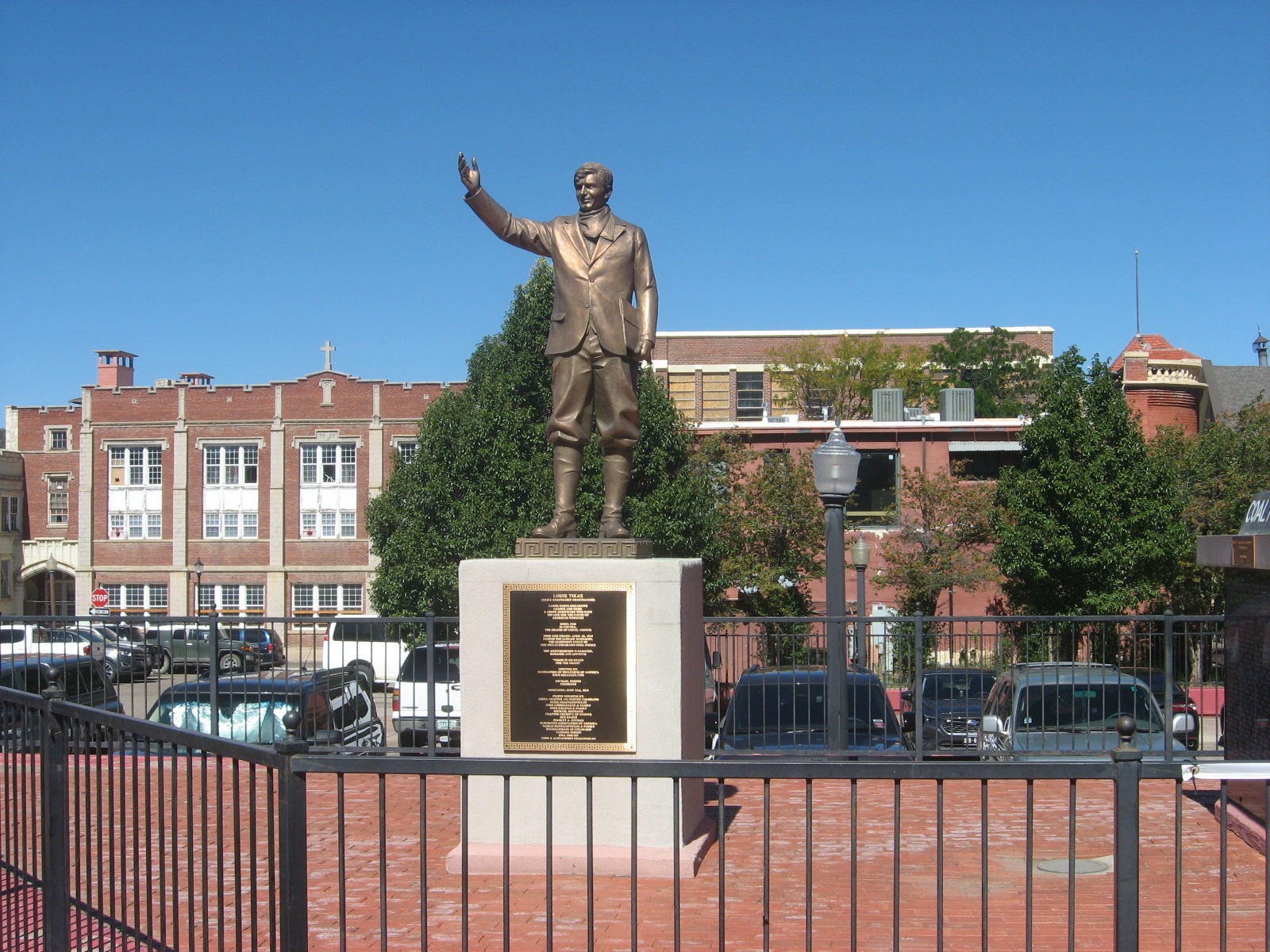
Picture 10 – Is a picture to the left of the Miners Memorial of the statue of Greek miner and tent camp leader Louis Tikas, assassinated by National Guard troops toward the end of the Ludlow Massacre. All those who died are listed on the back of the monument at Ludlow. I list them in order from top to bottom: Louis Tikas, Age 30 Yrs; James Fyler, Age 43 Yrs; John Bartolotti, Age 45 Yrs; Charlie Costa, Age 31Yrs; Fedelina Costa, Age 27 Yrs; Onafrio Costa, Age 6 Yrs; Lucy Costa, Age 4 Yrs; Frank Rubino, Age 23 Yrs; Patria Valdez, Age 37 Yrs; Eulala Valdez, Age 8 Yrs; Mary Valdez, Age 7 Yrs; Elvira Valdez, Age 3 Mo; Joe Petrucci Age 4 ½ Yrs; Lucy Petrucci, Age 2 ½Yrs; Frank Petrucci, Age 6 Mo; William Snyder Jr, Age 11 Yrs; Rodgerlo Pedregone, Age 6 Yrs; Cloriva Pedregone, Age 4 Yrs.


Monday, November 18, 2024

Voters to Elites: Do You See Me Now? - What David Brooks got wrong!


In his November 6, 2024 post election opinion entitled “Voters to Elites: Do You See Me Now?” David Brooks blames America’s elite and the Democratic Party for the Trump election. While millions can agree the Democrats have failed miserably in their number one job to “combat inequality,” Brooks ignores that corporate America has controlled the government and the economy and he ignores our pathetically out-of-date Constitution that allows small numbers to block anything progressive.

As Brooks was wrapping up he wrote “Well, Donald Trump hijacked a corporate party, which hardly seemed like a vehicle for proletarian revolt, and did exactly that.” Really! The Republican Party is certainly a corporate party, but Donald Trump has yet to hijack corporate America or take over running the economy. Recall Trump had a first term and during his 2016 campaign he made some very populist proposals to benefit the working class, all opposed by corporate America.

Start with 2016 candidate Trump who asserted the NAFTA trade agreement needed significant improvements, calling it a “disaster” and the “worst agreement ever negotiated.” He threatened to have the United States withdraw without the changes he demanded. From the beginning in 1994 NAFTA succeeded increasing trade, foreign domestic investment and Gross Domestic Product in the United States, Canada and Mexico to the great satisfaction of corporate America. When negotiations for a new Trump NAFTA began May 18, 2017 corporate America was there watching to make sure changes would be acceptable to them. From the beginning in 1994 critics like Ross Perot insisted NAFTA benefits flow to corporate America at the expense of U.S. jobs and the working class, and so contribute to inequality in income distribution. Trump had a point: unregulated free trade equals cheap labor at the expense of the working class, but corporate America ran the show to make sure nothing much happened. NAFTA remained while corporate America gave public relations deference to their brush off to Trump’s populist appeal.

Next came Trump’s populist demand to build a border wall and cut immigration that corporate America opposes and the Republican establishment blocked during the Obama years. Corporate America wants foreign immigration to provide cheap labor, but the Trump campaign promised to the working class that voted for him required that he fight corporate America and the Republican Party establishment and be aggressive in his efforts to restrict the flow of immigrants. Further he wanted to cut the number of legal immigrants coming in through the foreign labor certification program that permits U.S. employers to hire foreign workers on a temporary or permanent basis instead of American workers. These were the H1-B jobs as professionals, the H-1C jobs, as nurses in disadvantaged areas, H-2A, for seasonal jobs in agriculture, and H-2B, temporary certification for non-agricultural employment. Trump appealed to voters tired of having immigrants taking their jobs.

Trump made building a border wall be evidence of his commitment to cut immigration. After Trump’s inauguration corporate America remained silent and let him demonize and debase Mexicans and Mexican families to suit his political purposes. He separated families and put young children in detention while corporate America looked the other way knowing his threats were tall talk while they continued with foreign labor certification and continued to hire and employ documented and undocumented immigrants as their cheap labor.

These first term proposals would have benefited the working class had they been phased in over the four years of 2017-2021. It would have been the beginning of a limit on the flood of labor, but corporate America blocked them all; they want cheap labor. Trump agreeably signed corporate America’s new round of corporate and upper-class tax cuts and then they had him appoint a good and competent Federal Reserve Chair, Jerome Powell, to manage the macro economy while the micro economy lurched forward generating more inequality of income and wealth.

There is nothing populist or beneficial for the working class in Trump’s 2024 proposals, but Brooks ignores these policy reversals and the danger January 6 attacks implies for a second term. Consider Trump’s new mass deportation demand. It offers stark contrast to slowing immigration from the first term. The reported eleven million undocumented immigrants came here for jobs and we might suppose many have two of them. Deporting them will require confronting people at their work place and disrupting and depressing production, employment and the economy, not to mention the potential for violence. His tariff proposals reverse decades of lower tariff policy and trade agreements like NAFTA preferred and controlled by corporate America.

In 2024 Trump controls a majority of voters and controls the sycophants of the Republican Party, and he had little trouble getting corporate media to do their daily best for four long years to make him a legitimate candidate and get him elected. They have succeeded, but they did so figuring to control him in his second term as easily as they did in the first. Trump’s second term policy is to challenge corporate America’s long held prerogatives and allow him to displace their decades of control over politics and the economy.  His proposals make clear how badly he wants to divide and defeat America’s corporate Oligarchs in his second term. That Jeff Bezos of Amazon and the Washington Post would sit down with Trump just before the 2024 election and make an utterly corrupt deal illustrates how that might work. After getting outwitted by corporate America in his first term Trump views them as his last frontier.

Brooks writes that “Trump is a sower of chaos, not fascism. Over the next few years, a plague of disorder will descend upon America” but he fails to mention the chaos will result from a pitched battle between Trump and our corporate Oligarchy. Recent Presidents like Ronald Reagan, George H.W. Bush, Bill Clinton, George W. Bush, Barack Obama, Donald Trump, and Joe Biden either served corporate America or got brushed aside by them; no president has ever tried to take them on until now.  The odds are corporate America will prevail, but Trump shows no sign he cares what, or who, he will destroy and ruin in the process. Recall the white supremacist vigilantes from January 6, their destruction at the U.S. Capital, and their Confederate flag on the floor of U. S. Congress, it’s the perfect image of what is coming.

Sunday, November 3, 2024

Arthur Schlesinger Jr’s, A Thousand Days, - A Comment

Arthur Schlesinger Jr’s, A Thousand Days, - A Comment

In Arthur Schlesinger’s memoir of his years as an advisor to President John F. Kennedy, A Thousand Days, he wrote about the right wing as he saw them in 1965, the year of publication. You might get a sense of Déjà vu.

From page 750:

“The burst of right-wing activity in the early sixties was a predictable historical phenomenon. In conservative periods, like the fifties, the radical right was characteristically disorganized and dormant. Its members were soothed by the eternal hope that a conservative administration might do something they would like.” . . .
“But the election of a progressive administration generally has a galvanizing effect on the radical right. It grows desperate, convinced that the nation is in mortal danger, that it is five minutes before midnight, that it must rally and resist before it is too late.” . . .

He went on with “I first heard of the John Birch Society in an early warning letter of December 1960 from that fine old progressive Republican Alfred M. Landon. One heard a great deal more of it in the months following. The radical right appealed equally to the incoherent resentment of the frightened rich and the anxious middle class. It flourished particularly in states like California and Texas, overflowing over raw new money; in states like Arizona and Florida, where older people had retired on their pensions; in small towns in the mountain states, where shop keepers felt harassed by big business, big labor, and big government. The mood is one of longing for a dreamworld of no communism, no overseas entanglements, no United Nations, no federal government, no labor unions, no Negroes or foreigners – a world in which Chief Justice Earl Warren would be impeached, Cuba invaded, the graduated income tax repealed, the fluoridation of water stopped and the import of Polish hams forbidden.”

Remember this was written in 1965

Saturday, November 2, 2024

Imani Perry, South to America: A Journey Below the Mason-Dixon to Understand the Soul of a Nation

 Imani Perry, South to America: A Journey Below the Mason-Dixon to Understand the Soul of a Nation, (NY: Harper-Collins, 2022), 383 pages

Imani Perry teaches a variety of courses in gender, law, public affairs and jazz studies as a professor of African American Studies at Princeton University. Her book South to America has elements of a memoir, black history, black culture and a travelogue. Travelogue applies given section and chapter titles have the names of regions, states and cities she visited and writes about: Section I. just below the Mason-Dixon line, Section II. the mid-south, Section III. the south along the water including Cuba and the Bahamas.

In Appalachia, Perry visits Harper’s Ferry where she narrates the history of John Brown’s raid. The raid, its failure, and Brown’s execution are familiar to many, but Perry fills in some lessor known details like the participation of two black men, Shields Green and John Copeland, executed for their part in the raid.  Readers learn freedman built a one room school house at Harper’s Ferry in 1866. The school became Storer college, a historic black college. In 1906, the Niagara Movement for racial justice met there with W.E.B. Dubois and William Monroe Trotter in attendance. Perry writes the story of this conference. To them John Brown was a hero that made it possible for blacks to envision freedom.

Perry shifts to narrating a walk about Harpers Ferry and along the Shenandoah River. During her walk she encounters a Civil War re-enactor on the Confederate side taking the day off from his job in Washington, D.C. She dubs him Bob and describes their hour or so of cautious conversation before reflecting on the search for identity for Appalachia and the black people that live there.  Commentary ranges widely such as a midnight walk through an Appalachian Walmart, comments on Appalachia by Washington Irving and Edgar Allen Poe, a discussion of Appalachian coal mining, strikes and violence that brought momentary black and white class solidarity and a lengthy discussion of the Highlander School.

This Appalachian chapter has the characteristics of all the chapters. It has stories related to the chapter’s region and the black community there. She writes varied commentary of her visits with family, friends or the strangers she meets, which she reflects on as a black woman born in Birmingham, Alabama in 1972 and raised in the south. The chapters are sprinkled with a variety of seldom mentioned black accomplishments. I learned that a black jockey, Issac Burns Murphy, won the Kentucky Derby three times and that two black bartenders invented the recipe for the mint julep. She reflects on the music of Chuck Berry and James Brown and their seldom recognized influence on the music of Elvis Presley.

Stories and reflections come with reminders that race and class figure prominently in American history and contradict our ideals such as the Virginia chapter where Perry quotes a seldom quoted part of Thomas Jefferson’s biography: his racist views of black people. Many know of the Dred Scott case, but not his life on an Alabama plantation or what happened to his children after they were separated. That 380 acre plantation became Oakwood University and might be the site of their remains, but Perry reflects it does not matter “there are gallons of sorrow in the soil.”


Some of Perry’s stories reveal someone wrestling with class and its relation with race as it plays out today. Remember southern white boys fought and died by the thousands to save slavery for wealthy plantation owners, but those well-to-do plantation owners offered only one reward: whites could be above black people in the social class hierarchy. Trump reminds us that insistence remains in the United States of 2024, as Professor Perry so well knows.

As an educated member of the professional class Perry tells a story of attending a writing retreat in Louisville, Kentucky with a group of black women professors. “By the external measure, we were a group of Black women who had scaled the heights.  . . . Some of us could trace our ancestries back to the plantations here, others to plantations in the Caribbean.  . . . Some came from elite families, most from struggling ones, all from people who eked out from under the race and gender rules. The past for us was something sorrowful and beautiful at once.”

At the end of their retreat, they took a tour of distilleries; Perry called it a bourbon tour. “I loved it. The science, the aging process, the history. The scent was intoxicating.” . . . But then, she relates “In retrospect, knowing what I know now, and reflecting on the sensory and social pleasure of that visit, I feel uncomfortable.” On the tour she learned these Kentucky distilleries emerged during slavery and depended on slave labor. “Don’t we always need to look round the back to see what made all this happen? Should I have reveled so easily in the bourgeois luxury?  . . . “This is a bit of navel-gazing, but if you gaze anywhere with a critical eye, you do have to look at your own belly, too.”

The narrative has lots of navel-gazing, or as I would call it, reflecting on race relations in a personal way, as an insider. In more navel-gazing Perry reflects on a trip to the Bahamas and the gulf between her and the black women that worked at her hotel. “It is an uncomfortable feeling.  Being an African-American, even an upper-middle class African American, often insulates you from the guilt of empire. After all, ‘we,’ in any collective sense, have never been the ruling class.  . . . But the truth is that relaxing in a multinational hotel makes me a part of the problem that people like [the maid for my room] have to manage, and for too small a compensation. I became her monster and she is mine, though she is blameless.  Because just a generation ago, my people were her. I’ve laid claim to a heritage that includes women situated just as she is, yet here I am one of her exploiters.”

The book coheres as a memoir because so much of the narrative covers Perry’s personal feelings and includes commentary of her experience and of her family’s experience as part of the black community, and on writers, composers, and activists connected to black history and culture. She quotes from, and comments on, people both black and white like W.E.B. Dubois, Ida B. Wells, H. L. Mencken, Langston Hughes, Ernest Hemingway, June Jordan, Flannery O’Connor, Toni Morrison and many more. There are no footnotes, no bibliography, as would be required of academic writing, and no “academize” to burden the reader.

The book’s narrative stays below the Mason-Dixon line as the subtitle, A Journey Below the Mason-Dixon to Understand the Soul of a Nation, suggests it will. Readers will find dozens of stories of white, mostly male, discrimination against blacks. Some are mid length; some are short. Some come from long ago; some are more current. Among recent cases include discussion and comments on the murderer of Trayvon Martin, the Duke Lacrosse rape case, and the murder of George Floyd and Breonna Taylor: “Our hearts broke for Breonna.” While the book has no obvious thesis if what Perry narrates of the south applies to the soul of the nation, then America continues to be racist.

Even so there are quite a few millions of white people who have, or had, black classmates as students, have black colleagues at work, and more and more have black neighbors. These whites can feel accepting, respectful and friendly toward the black people they know, even as they avoid thinking about white racist misconduct. Let me suggest the moderate tone in her writing and naval-gazing brings an optimistic note to the end of the book, and an invitation for whites to rethink what should be the soul of the nation.