Showing posts with label Reviews. Show all posts

Monday, October 12, 2026

The Containment, A Review

Michelle Adams, The Containment: Detroit, the Supreme Court, and the Battle For Racial Justice in the North, (NY: Farrar. Straus and Giroux, 2025), 389 pages

In the prologue to The Containment author Michelle Adams offers some personal background of growing up in the Palmer Park neighborhood of Detroit, enrolling in the Roeper City and Country School in 1967, finishing high school in 1981 and later becoming a civil rights attorney and University of Michigan law professor.

As an attorney Adams wrote an amicus brief on behalf of the National Parent Teachers Association in the 2006 case of Parents Involved in Community Schools v. Seattle School District No. 1. The Seattle case erupted over another dispute from a race-based effort to integrate Schools, much like the one in The Containment back in Detroit in the 1960’s. The new case offered the John Roberts Court the opportunity to strike another blow against race based integration, which it did. No surprise there but she explains it was the failure of Justice Breyer’s dissent to connect overturning Brown v. the Board of Education to Detroit in the 1960’s that motivated her to tell that story.

The book is divided into three parts, each with eight chapters. Part I, entitled the Soul Force, describes the segregated Detroit schools in the 1960’s and narrates the contending arguments and proposals to relieve it. Adams provides names and short biographical sketches of the many people and their arguments for change to help readers sort through the history. Several factions offered proposals to bring black community control while others proposed various plans for integration with the School Board the focus of protest and demands for change.

The Supreme Court ruling in Brown v. Board of Education made government sponsored segregation, defined as de jure segregation, an unconstitutional denial of equal protection, but de facto segregation existed in Detroit given blacks and whites lived in segregated communities and went to segregated schools. The NAACP sponsored a search for the evidence that segregation was intentional as opposed to the benign result of individual choice.

When the Detroit Board of Education voted to approve an integration plan after considerable debate and discussion, widespread opposition blocked its use. Next, an alternative proposal by then state representative Coleman Young was signed into law as Public Act 48 on July 7, 1970. It partitioned Detroit schools into 8 districts with 4 having a black voting majority and 4 having a white voting majority, but it had nothing about integration; it satisfied no one. Part I ends when Detroiters recalled the school board in a vote August 4, 1970.

Part II, entitled the Containment, starts with the case of Bradley v. Milliken, a case challenging Public Act 48. Plaintiff Vera Bradley was a black mother with a son in a Detroit elementary school and Milliken was William Milliken, Michigan Governor. The complaint alleged de jure segregation and that the Board had been deliberately segregating the schools for many years. Adams needs 130 pages to narrate the case through the federal court from an initial August 27, 1970 hearing before Judge Philip Roth to his June 14, 1972 order to carry out a Metropolitan School Plan to be completed by 1973.

The narrative covers a skeptical Judge Roth who denied a motion to restore the Board’s integration plan, which the NAACP appealed to the 6th Circuit Court. The court’s opinion concluded “State action in any form, whether by statute, act of the executive department of a state or local government . . . will not be permitted to impede, delay, or frustrate proceedings to protect the rights guaranteed to members of all races under the Fourteenth Amendment.” The 6th circuit remanded the case to Judge Roth and a trial followed.

Adams provides a thorough and detailed discussion of the evidence and proceedings of the trial, including a review of public comments and their newspaper and TV coverage as well as the legal influence of related school integration cases from other cities. One of the many new attorneys to the case explained “Containment” to Judge Roth as “not a fortuitous phenomenon” . . . but . . . “the result of private and public housing discrimination.” Adams commented that “blacks were viewed as contagions to be quarantined and avoided at all costs.”

Trial evidence included detailed maps of black and white Detroiters living separately, restrictive racial covenants enforced by courts, Federal Housing Administration and federal Home Loan Owners Association discriminatory policy, mortgage lending “redlining,” real estate agents and brokerage discriminatory policy and practice. After ten days of trial, defendants admitted Detroit was segregated. The trial went on with testimony of Dr. Robert Green, a professor of educational psychology and then to testimony of parents and their experience in segregated schools that included busing black children through white neighborhoods to segregated black schools.

On September 27, 1971 Judge Roth made his “Ruling on Issue of Segregation” concluding Detroit segregation was the result of intentional practices, that the state of Michigan assisted in operating and maintaining the system in violation of the equal protection clause of the 14th amendment. Judge Roth did not offer a desegregation plan but instructed the plaintiffs and defendants to discuss and propose desegregation plans. As discussion got underway Governor Milliken announced the state would appeal Judge Roth’s decision in a speech November 3, 1971. Judge Roth’s metropolitan desegregation order did not come until June 14, 1972, but opponents and proponents were already aligned to fight or defend cross district integration the newspapers labeled as “busing.” Part II ends.

The concluding Part III follows the legal steps to the end of the case. As promised Michigan Attorney General Frank Kelley appealed to the 6th Circuit Court July 13, 1972. In December, the 6th Circuit upheld Judge Roth.  Michigan then appealed to the entire 15 judges of the 6th Circuit, known as “en banc” review. The 6th Circuit affirmed Judge Roth again. Michigan requested a hearing before the Supreme Court, which became the case of Milliken v. Bradley. On July 25, 1974 the Supreme Court overruled Judge Roth’s order and sent the case back to the district court to devise a Detroit only integration plan. Judge Roth had passed away and a new Judge, Robert DeMascio, was charged with developing a Detroit only integration plan in a school district

Adams adds a thorough narrative of the politics connected to the final legal ruling in these Part III chapters. By now school integration efforts are routinely referred to as busing in national news coverage. Adams devotes a chapter to Richard Nixon and his opposition to busing and dislike of the egalitarian views of the Warren Court. There are profiles of Lewis Powell, William Rehnquist, and Warren Burger that Nixon appoints to the Supreme Court. Another chapter narrates the rationalizations the justices employed to overturn metropolitan school desegregation. Justice Powell did an especially good job deceiving himself that his opinion was all about law and not his white, upper class view of the world. Other justuces ignored that state governments are sovereign and can control schools and redraw school boundaries at any time. The Court’s ruling justified segregation and turned suburban borders into immutable barriers black children cannot cross on the way to school, like fences Adams suggests. The Milliken v. Bradley ruling repeats Plessy v. Ferguson with another separate but equal ruling for the 20th century and beyond.

The final two chapters fast forward to the present to explore consequences from the Milliken v. Bradley and Detroit segregation in 2025. A 12 page epilogue describes the author’s 2019 return to Detroit with some musing and reflections. Editors and authors like to end books on a positive note, but doing so here was a struggle. In the last four pages Adams remarks on the threats of continuing racism in a nation that feels “like two warring tribes” maintaining a “sanitized” education system that evades the truth. Adams mentions January 6 and current racist division like Tucker Carlson and the “great replacement theory” in a country where we must not “forget our boats rise together or they don’t rise at all.”

The Containment has many people and many related court cases that makes the book complex, but it avoids legalese and reads as well thought out history rather than journalism. Adams has a cast of characters’ list and their part at the beginning of the book and it is well documented at the end. Adams avoids mention of the depressing trump, but keeping him out of the story did not help me feel optimistic about the future. No boats rise now in the United States.


Thursday, July 9, 2026

The Betrayal - Ira Shapiro

 Ira Shapiro, The Betrayal: How Mitch McConnell and the Senate Republicans Abandoned America, (Lanham, MD: Roman & Littlefield, 2022) ISBN 9781538163979, 241 pages

In the first sentence of his preface author Ira Shapiro declares The Betrayal as “the most catastrophic failure of government in American History.” A brief discussion of constitutional checks and balances reminds readers our Constitution should be able to prevent autocratic takeover of government. There follows a summary listing of failures of government with Mitch McConnell directing the Republicans and the U.S. Senate, along with a reminder that Trump needed McConnell more than McConnell needed Trump.

The book has eleven chapters and a brief epilogue. The first chapter reviews some Senate history from not that long ago when Mike Mansfield managed the Senate and persuaded Republicans and Democrats to respect each other and their constitutional duties. The second chapter reviews the career and work of Mitch McConnell before Trump took office; especially during the Obama administration.

The remainder of the book covers the period from Trump’s 2016 election to the end of 2021. The chapters recount Mitch McConnell managing his political agenda and on multiple occasions managing Trump during Trump’s first term. McConnell worked hard to repeal Obama Care but fell short, his only personal failure. Next, Shapiro narrates the maneuvers that put Neil Gorsuch on the Supreme Court. There follows the story of saving Brett Kavanaugh for another Supreme Court seat.

After the Democrats took charge of the House following the mid-term elections, McConnell announced his return to obstructing Democrats and Congress in any way possible. The House voted to impeach Trump after his attempt to extort political favors from Ukraine officials, which McConnell predictably opposed and defeated. Shapiro narrates McConnell’s strategy for a Senate trial with its foregone conclusion.

By now in early 2020 with the Covid-19 Pandemic under way, Shapiro tells the story of Trump at his “super spreader” worst with McConnell “curiously disengaged” while occasionally maneuvering between common sense and partisan politics as suited his personal agenda. Then RGB dies and McConnell swings into action to get Amy Coney Barrett, a Scalia protégé, onto the Supreme Court before the 2020 election.

Next comes the 2020 presidential election in a chapter entitled appropriately “The Big Lie.” McConnell refused to condemn Trump for this election denial, which he described as “a few legal inquiries.” When McConnell belated realized that Trump’s misconduct had ended his run as majority leader, he finally got angry enough to speak against him and defend the election in a Senate speech Shapiro quotes in its entirety. Unfortunately for McConnell his speech was delivered on the morning of January 6.

Shapiro recounts daily events leading up to the attack and then a concise discussion of the January 6 events. The attack was so violent and so obviously planned by Trump that the House Democratic majority had enough votes to bring another impeachment. The account of the impeachment and trial follows where Shapiro provides the evidence that McConnell could have delivered the Senate votes to convict, but found an excuse to vote in Trump’s favor.

The book winds down considering the prospects for President Joe Biden in a Senate with a 50-50 split that included erratic allies like Joe Manchin and opponents like Mitch McConnell. A foul mouthed and disruptive ex-president, still a profitable topic for media coverage, attacked every Biden effort.

The stories narrated through the book come peppered with the conduct and quoted views of many people. Of course, there is Trump, but other names come up many times such as dithering Susan Collins, the amoral Lindsey Graham, Mitt Romney, Lisa Murkowski, Lamar Alexander, Amy Klobachar, Charles Grassley, Joe Manchin, Joe Biden, Nancy Pelosi, Rudy Giuliani. Still the book remains primarily about the political misconduct of Mitch McConnell and his legacy. Shapiro suggests a legacy for McConnell, but given the brevity of his comments he appears more inclined to let McConnell’s record speak for itself.

While the record is clear, Shapiro uses his final pages to remind us McConnell served as majority leader longer than anyone while suggesting a broader and more damaging legacy than what he did to remake the Supreme Court and save Trump from his various follies. While these make up the primary topics of the book, Shapiro mentions McConnell’s work cutting taxes for the rich, deregulating corporate America, and his fight to end Biden Administration efforts to address climate change, an especially unconscionable misconduct for an 80 year old who will not live to bear the consequences of his work. In summary conclusion, “McConnell has ultimately come down on the side of polarization and disunion rather than compromise and reconciliation.” From McConnell’s published memoir, he comments “there is not a page in it that shows concern about the people of Kentucky.”

The book ended without exploring polarization and disunion in more detail or how much McConnell has pursued the corporate agenda like a devoted follower and paid employee. Corporate America promotes and benefits from the racial and ethnic hatreds that divides the electorate. Division turns the working class into warring factions and keeps them in feeble disarray while allowing corporate America to take their wealth by intentionally impoverishing the working class.

The book reads easily as well organized and well documented journalism. There are 30 pages of notes and a four page essay on sources that serves as a bibliography for any interested readers. Betrayal serves as another book on the continuing decline of the United States. Remember the book’s publication date of 2022; well before the second term. Maybe disunion should be replaced by disintegration


Thursday, May 28, 2026

We the People


Jill Lepore, We the People: A History of the United States Constitution, (NY: Liveright Publishing Co., 2025) 581 pages

We the People begins with an introduction establishing America’s 18th century colonists expected constitutions will be amendable. Toward the end of this 22 page introduction author Lepore explains the “book is a history of American constitutionalism as told through a collection of stories about constitutional change.” It relies on an archive of every significant proposal to amend the U.S. Constitution, assembled as part of a personal project of the author.

The book has four parts with each part subdivided into three, or once four, chapters. Parts follow in chronological order with Part I from 1774 to 1791; Part II 1803-1896; Part III 1905-1959; Part IV 1961-2016. A brief epilogue ends the book.

Part I opens with the First Continental Congress in September 1774 when the colonies sent delegates to draft a constitutional document to replace British colonial government with a system of self-government. Lepore takes readers through state conventions drafting and attempting to ratify their constitutions and then to the drafting of the 1781 Articles of Confederation.  Narrative continues with the arguments writing our U.S. Constitution at the 1787 Constitutional Convention, the difficulties getting it ratified, and the ultimate drafting and adoption of the bill of rights.

Small groups drafted these many constitutions and then made them public hoping to get them ratified, but mostly they got a torrent of criticism and demands to change them. Opposition to slavery was strong and attempts to end it and define the rights of blacks brought lots of arguments, as did the constitutional status of women and Indians. When the delegates that worked through the summer of 1787 finished their work, there were renewed demands for amendments. Since their new constitution included Article V detailing an amendment process, James Madison convinced opponents they could amend after ratification. He succeeded in getting the constitution ratified as originally written by condensing the many proposals into ten amendments put at the end of the constitution as the Bill of Rights.

In 1787 it was not obvious amending the constitution would be as hard as it has turned out to be. In each of the remaining three parts Lepore has pages with lists of proposed amendments made as part of political party platforms. The lists provide topics for narrating the repeating demands for change by formal amendment, for narrating alternative constitutional interpretations and for reviewing Supreme Court rulings on constitutional disputes brought to it.

Part II has a thorough discussion of controversies over citizenship, the 1843 Seneca Falls women’s rights conference, voting rights, the nullification claims of John C. Calhoun and the claims of Chief Justice John Marshall to make the Supreme Court the final arbiter of constitutional disputes. Discussion of many Supreme Court cases and their influence on law and politics begin here with Marbury v. Madison and continues through the narrative where readers meet more justices with new views and new cases, often contesting and reinterpreting disputes.

The narrative considers the legal and constitutional chaos of the Civil War and reconstruction. Members of Congress proposed many amendments as a hope to avert war. One, the Corwin Amendment, would have prohibited amendments to abolish slavery. It would come again in March 1956 as the “Lost Amendment.” There is a thorough discussion of the 13th, 14th and 15th amendments and the effort to define citizenship and guarantee civil rights to all. Lepore considers the controversies over rights to self government for those living in U. S. territories, especially Hawaii and Hawaiians, but also Chinese, Japanese and American Indians.

The Part III period 1905-1959 included the amendments 16 through 19 ratified from 1913 to 1920, where three of the four amendments – income tax, prohibition, and women’s suffrage – came after decades of protest. An amendment to abolish child labor began appearing on party platforms in this era, mostly as a response to the Supreme Court refusal to allow it; it failed. Lepore gives a thorough review of the Brown v. Board of Education of Topeka Supreme Court decision, the protest that followed and demands to repeal it by defiance or amendment.

In the Part IV years 1961-2016 readers meet Indiana Senator Birch Bayh who took over the Subcommittee on Constitutional Amendments in 1963. He convinced the country and the Congress to ratify amendment 24, 25 and 26 and almost succeeded abolishing the electoral college via another amendment. It was an era of well funded interest groups which brought an unprecedented number of Article V applications for constitutional conventions. Lepore explores a variety of amendment proposals for the right to life, school prayer, a balanced budget, busing, campaign finance, Indian rights and the controversies over judicial appointments. There follows another lengthy discussion of women’s rights and the ERA that includes the efforts of Patsy Takemoto Mink, Phyllis Schlafly and Supreme Court nominee Robert Bork, along with a review of gay rights, black rights and calls for significant changes to the constitution.

The last chapter before the epilogue features the life and career of Justice Antonin Scalia during the years he served on the Supreme Court: 1986-2016. Featuring Scalia appears to be a device to narrate the polarizing jurisprudence of a period when constitutional amendments became impossible. Since Scalia left a trail of academic writing and did not hesitate to give speeches, conduct seminars and offer his judicial views in television interviews, his claim our constitution had an original intent to guide jurisprudence free from politics and personal preference generated significant public argument in these years. Lepore narrates these arguments, emphasizing Scalia’s gun rights opinion in D.C. v. Heller, which captures the hypocrisy of it all.

In her brief epilogue Lepore reminds us our founding fathers believed in reason and progress, but mentions “outdated constitutions undermine democratic governance.” Then she questions if there is a point beyond which a constitution cannot be stretched but breaks. Our Constitution feels obsolete, to be charitable. In We the People Lepore makes it feel much worse than obsolete. By covering events from 1774 to the present Lepore establishes the same disputes occur and then recur as unresolved politics from one century to the next: women and minority rights to wit. Powerful interests have repeatedly exploited the undemocratic features of our constitution to block and stall and impose their will without regard to compromise or democracy or public welfare as the many events Lepore narrates here so clearly prove. Legislation is hard enough to pass in our bicameral Congress, but given the Supreme Court expects to nullify laws passed by an elected Congress, disputes that could and should be resolved with legislation become amendment proposals instead: abortion to wit. Since Article V makes amendment difficult to impossible, change comes to a halt while protest continues or returns in a new generation. The book fully captures the rambling, hurtling cycles of anger, frustration and chaos in a perpetually polarized country. In the 21st century money alone governs America, where our outdated constitution undermines democratic governance.

Monday, January 5, 2026

Woodrow Wilson: The Light Withdrawn

Christopher Cox, Woodrow Wilson: The Light Withdrawn, (NY: Simon & Shuster, 2024), ISBN 978-1-6680-1078-5

This new biography of Woodrow Wilson gets its subtitle from the first line of the John Greenleaf Whittier poem “Ichabod.”

So Fallen! So lost! The light withdrawn

Which once he wore!

The Glory from his gray hairs gone

Forevermore!

Biographies of presidents typically emphasize their time in office and the political events they pursue, but this biography concentrates on racial and gender discrimination during Woodrow Wilson’s life and how he addressed them before and after he became president The book covers 495 pages with the narrative partitioned into four parts. Part I begins with a summary discussion of the early crusade against slavery and women’s suffrage movement before turning to Wilson’s 1856 birth, early life, education, a brief year practicing law, marriage and accepting faculty posts teaching at Bryn Mawr, Wesleyan University, and Princeton University; he accepted the Princeton Board’s offer to be their president in June 1902.

Other Wilson biographies write extensively of his legislative record: the Federal Reserve Act, Clayton Antitrust Act, Federal Trade Commission Act, and progressive income tax, but none of that appears in this Cox biography. Instead, the narrative through the book emphasizes the documented record of Wilson’s personal relations with family and friends and with university scholars and politicians, both his supporters and detractors. Beginning with his academic years he published books of history and politics in 1885, 1889, 1893, 1897, and 1902. Cox scoured these works and Wilson’s other writing, archival letters, relationships, and associations. The narrative returns repeatedly to the published record of his racial views and his decades long opposition to woman’s suffrage.

The chapters of Part I offer a sampling of Woodrow Wilson’s views during Reconstruction and the early Jim Crow south. He predicts the right to vote without regard to race would “make the ‘disintegration of southern society’ and the ‘irretrievable’ alienation of ‘the white men of the South,’ its ‘real leaders.’” In his History of the American People he explained “It is ‘the mere instinct of self-preservation’ that forced ‘the white men of the South’ to do everything within their power to restore white supremacy ‘by means fair or foul.’”  Wilson’s apologizes for the Ku Klux Klan admitting “the Klansmen ‘took the law into their own hands,’ but undertook ‘by intimidation what they were not allowed to attempt by the ballot.’” He concluded the Klan was “really ‘for the mere pleasure of association, for private amusement.’” Cox provides a thorough narrative of his discomfort and unlikely appointment to teach at Bryn Mawr, a women’s college. Bryn Mawr documents an early episode of a long trail of evidence documenting Wilson’s refusal to accept women as equals.

Part II offers a discussion of him as Princeton President, elected Governor of New Jersey and first term as president. His years in politics forced him to take positions and make decisions on race and woman’s suffrage rather than write or ventilate about them. Cox quotes Wilson as telling his gubernatorial campaign manager he was “definitely and irreconcilably opposed to woman suffrage” and that “woman’s place was in the home.” His writing and documented decisions find him opposed to admitting black men to Princeton, opposing unions, opposing immigrants and purging the federal government of black employees while arranging to have the racist film “Birth of a Nation” shown at the White House.

Available evidence permits Cox to give readers an idea of Wilson in his personal life. Hundreds of letters survive to and from his two wives, Ellen Axxon and Edith Galt, and a third relationship with Mary Peck Hulbert. In letters to Ellen, he wrote “Marriage alone was a woman’s ‘essential condition’ for the performance of her ‘proper duties.’” Readers learn Wilson leaves on vacations without Ellen such as one to Bermuda where he meets Mary Peck and starts an indeterminate relationship of eight years documented with 700 letters. We learn of the personal Wilson, a man of “immutable routines,” who enjoys taking afternoon drives and plays golf as part of his daily schedule, finishing 1,200 rounds of golf as president.

Part III, entitled Holding Back the Tide, covers December 1916 to December 1917, a period that energized the Women’s suffrage movement with intensified political pressure to secure national voting rights. Cox covers their campaign thoroughly. Readers meet many women, the groups they organize and the protest marches and demonstrations they conduct. During this period, Wilson reversed his pledge to keep America out of WWI. He prevailed on Congress to declare war to make the world “Safe for Democracy” while simultaneously demanding to silence opposition to American entry into WWI in a well-documented campaign of repression and censorship. During this period the war became an excuse for Wilson to repress and censor woman demonstrating for voting rights. Cox narrates Wilson’s deliberate use of arrest, intimidation and violence to end street protest that included periods of physical abuse in jails and forced feeding of hunger strikers.

Part IV has the remaining years of his second term. By this time women had the right to vote in 13 states, including New York, increasing the political risk to Democratic party opponents of voting. Then Republicans took over the House and Senate in the November 1918 election. When WWI ended November 11, Wilson insisted on going to Paris to negotiate the peace treaty and establish a League of Nations instead of staying home to confront domestic turmoil, especially passing a federal budget, inflation and violent race riots. Cox tells the remaining story of Wilson maneuvering within his administration and his posturing in the House and Senate in the political fight to secure voting rights for woman. Cox gives details of the Congressional debate and final votes in June 1919. Tennessee became the last state to ratify the Susan B. Anthony Amendment that finally became part of the U.S. Constitution August 18, 1920. The narrative ends here, or rather just stops.

Over many years I have read dozens of biographies of Presidents including Woodrow Wilson. None I know of leave out so much of their political record to focus on the man and the ethical principles that drive their decisions and their conduct as this biography. Any illusion that Woodrow Wilson was a confident, accepting and fair-minded gentleman disappears in this Cox biography. The glory from his gray hairs gone. Forevermore!


Monday, December 1, 2025

Original Sin: President Biden’s Decline, Its Cover-Up, and his Disastrous Choice to Run Again

Jake Tapper, & Alex Thompson, Original Sin: President Biden’s Decline, Its Cover-Up, and his Disastrous Choice to Run Again, (New York: Penguin Press, 2025), ISBN 9798217060672, $32.00 

 I was given a copy of Original Sin and read it wondering what it could tell me of the Biden saga that I did not already know? We know Joe Biden was 82 for the 2024 presidential election and would be 86 at the end of a second term. How much more information did I need since I could see he had aged just looking at him on television and then he accepted a debate with Trump, which ended any doubt about another term given the blank pauses and fumbling speech. In the Author’s Note they tell readers “Our only agenda is to present the disturbing reality of what happened in the White House and the Democratic presidential campaign in 2023-2024, as told to us by approximately two hundred people, including lawmakers and White House and campaign insiders, . . .” 

 The book has 19 chapters and runs 314 pages and I can testify the authors did an impressive job organizing the material from all those interviews and writing a clearly worded narrative. The primary story they tell shows Joe Biden, his wife Jill and his loyal White House advisors unable to face the very real doubts of a second term; there was denial and a loss of objectivity but nothing Joe Biden did could be called a cover up, a term that connotes legal misconduct. Since presidents have to be visible, their family and advisors have no duty to offer any doubts they might have to the public; the public must expect to make up their own mind. 

The authors interviewed Democratic and Republican office holders, party officials, pollsters and other journalists, both necessary and appropriate, but they added related personal and family history to the primary story. I tried to connect the discussion of the Biden family troubles of sons Beau, and Hunter and daughter Ashley, but that discussion always felt tacked onto their stated purpose: “Our only agenda is to present what happened in the White House and the Democratic presidential campaign.” 

 I found it difficult to construe the loss of son Beau to cancer and Hunter’s legal missteps as part of President Biden’s Decline, or his decision to press on for a second term. The discussion of these matters feels especially callus and unnecessary given just the facts the authors provide. They explain “The Plea Deal.” Hunter would plead guilty to evading $200,000 in income taxes and illegal possession of a fire arm. Biden opponents howled their objections and the federal judge in the case, Maryellen Noreika, a Trump appointee, refused to accept the plea deal, dragging out the case further. 

As I recall President Biden promised to allow his appointed Attorney General, Merrick Garland, to go ahead and prosecute Hunters case as part of his general promise to avoid interfering with federal law enforcement, but that was before losing the 2024 election and listening to Trump make repeated threats to him and his family with claims the Biden’s were part of an “organized crime family.” Recognizing the harassment Trump would create for his family he used his pardon power to protect them at the last moments of his term. In doing so, he was defensive and suggested toxic politics had something to do with the outcome of the case and his need to give blanket pardons. For this decision, the author’s make sweeping condemnation; they quote the prosecutor characterizing the pardons as “gratuitous and wrong” and that Merrick Garland was “tremendously disappointed” and that “To many Democrats, this was another ignominious act by a president who repeatedly put the interests of his family ahead of those of this party and country.” These conclusions feel sanctimonious and hypocritical given Trump’s pardons of hundreds of the January 6 felons. To some of us Hunter Biden’s crimes feel trivial compared to assaulting the U.S. Capital and refusing to accept the 2020 election results. 

I struggle to find a purpose for writing the story of Joe Biden’s Decline. A four page conclusion chapter asks “What if a president is unable to discharge their duties but doesn’t recognize that fact?” The authors admit those close to President Biden were always ready “to attest to his ability to make sound decisions if on his own schedule.” There is a suggestion Congress could legally require the president’s physician to certify to Congress the president is fit to serve, but so far in U.S. history only death assures a president will be unfit for office; there is no mention that anyone in Congress has offered such legislation. The authors mention several other questionable presidents, but offer no solution to future presidents and evaluating their qualification for office. 

 If there was a lessen for the future in the Joe Biden case I could not find it in Original Sin. I make note that both authors have worked in corporate media and wonder if they could keep their jobs writing a similar book about Donald Trump? .

Wednesday, October 8, 2025

Coming Up Short

Robert B. Reich, Coming Up Short: A Memoir of My America, (NY: Alfred A. Knopf, 2025), $30.00, ISBN 9780953803288

In his newest book, Coming Up Short, author Robert Reich offers readers a unique combination of personal memoir, U.S. history and policy discussion condensed into 350 pages. Born in 1946 he grew up as a founding member of the boomer generation. He lived through the Civil Rights and Vietnam War era while a student and then took an active role in politics, serving in judicial and administrative appointments during the Ford, Carter and Clinton administrations. While he never held political office, he made an unsuccessful run for governor of Massachusetts and served as an informal advisor to political candidates and office holders during his years as a professor in academia.

The narrative follows a rough chronology through his life divided into six parts that serve as chapters.  Since he met bullies growing up in South Salem, New York and attending Lewisboro elementary school, standing up to America’s rich corporate bullies becomes a theme guiding the narrative. Education at Dartmouth College, Oxford as a Rhodes Scholar and Yale Law School and his work as a clerk to a federal judge, Assistant Solicitor General to Robert Bork, policy director at the Federal Trade Commission, and Secretary of Labor allowed him to meet dozens of future and current politicians and write opinion informed by personal experience.

Reich expresses his support for equal rights and social justice with the stories of his encounters with dozens of politicians and celebrities he met during his career. Boomers especially get a chance to reconsider old events in a new perspective. In 1965, as Dartmouth class president, he met Hillary Rodham, then a student at Wellesley College, and then introduced her to Bill Clinton six years later while they and Clarence Thomas were all Yale law students. While still a student  he was an intern for Robert Kennedy, then volunteered for the Gene McCarthy presidential campaign, traveled to England with Bill Clinton to be Rhodes scholars and figure out how to evade the Vietnam draft. He met Robert Bork while his law school student and then worked for him when Bork was Solicitor General. A 22-page saga of Bork’s career and the origins of the term “Borked” follow. Reich suggests Bork deserved better than he got from the press and Congress.

Reich titles Part III, The Giant U-Turn, that identifies a 1971 letter of attorney and later Supreme Court justice Lewis Powell to the U.S. Chamber of Commerce recommending a shift of corporate America to “mobilize for political combat.”  Before describing some of the resulting abuses and characteristics of corporate misconduct, Reich describes his work with the Carter administration and defends President Carter as not as bad as we think. In two other sections he discusses his relationship with John Kenneth Galbraith and a professorial tenure battle of his wife while at Harvard.

Part IV has eighty pages, the longest in the book, which Reich entitles Failure. It describes his work as a Democratic party advisor to Senator Gary Hart, Governor and presidential candidate Michael Dukakis, and Bill Clinton.  After Clinton wins the presidential election he becomes Secretary of Labor, which he hoped would allow him to pursue an agenda to benefit the working class. Reich describes his failed efforts as Secretary of Labor by narrating his bureaucratic policy battles with Secretary Robert Rubin and with stories of Alan Greenspan and others.

One of his failures occurred at a Bridgestone tire plant in Oklahoma where a failure to install safety cutoff switches had killed and injured workers and remained as a risk to injure more. Reich responded to the failure by seeking an emergency order to require installation of cutoff switches and imposed a $7.5 million fine. The company denied all wrong doing and threatened to close the plant. Reich backed down: “The bullies won. I am haunted by our failure. All I had considered was the moral superiority of my position and the thrill of the spectacle. I hadn’t imagined Bridgestone would take hostage the livelihoods of more than a thousand people.” He was haunted because he made the wrong decision to give in! He left the job at the end of Clinton’s first term to spend more time with his kids; a claim we can believe but readers might conclude, as I did, that he was worn out with Bill Clinton and his Wall Street tilt.

In the gathering storm, the title for Part V, readers get subtitled commentary on episodes of misconduct and cowardice by individuals in positions of leadership. Reich quotes from a speech he made to the Democratic Leadership Council where he warned them of a two tiered society of winners and losers. After the warning come stories of people who promoted or acquiesced in the two-tier society: Roger Ailes, Rush Limbaugh, Bill Clinton, Al Gore, Barak Obama, Alan Greenspan, Robert Rubin and others.

About midway through Part V Reich switches to the aftermath of the Bush recession to discuss the tea partiers, occupiers and other angry people.”  There is special mention of the cowardice of Clinton and Obama: “Both Clinton and Obama stood by as corporations busted trade unions, backbone of the working class.” Recall Obama did not prosecute the Bush era banking looters. Reich recounts visits to Michigan, Wisconsin, Ohio, Pennsylvania, Kentucky, Missouri, and North Carolina and the anti-establishment rage he found there. He goes on to discuss the end of the American Dream and the end of the Republican party as a political party. The final subsection offers the five elements that make fascism. He finishes with “Americans can preserve our democracy and share our prosperity only by attacking and countering concentrated wealth and the political corruption that accompanies it.” 

Part VI, The Long Game, ends the book with a smorgasbord of personal stories, a few suggestions, and a tiny slice of optimism. One story was his failed campaign for Massachusetts governor. As a political advisor he thought he knew elective politics but running for office taught him the essential personality traits he does not have: narcissist, extrovert, method actor, thick skin, and also avoid consultants and be respectful of media. He concluded “Running for office made me even more keenly aware of the role and responsibility of mainstream media in a democracy in danger of coming apart.”

Other stories describe an aborted appearance with “Dr. Phil,” his friendship and admiration for Bernie Sanders, the pleasure of seeing and remembering some of his students. The last pages have some broad suggestions for restoring capitalism, reclaiming patriotism, creating better workplaces, and sharing profits. The book ends with thoughts on growing old, 79, and the need for the younger generation to take over and restore democracy.

The Reich book is built on the same ethical principles as similar books and commentary by others like Arlie Russel Hochschild, Heather Cox Richardson, and recent books of Steven Brill and David Leonhardt. However, his 60 year career in politics and academia required him to confront an unusually long list of political disputes and meet an unusually long list of people who became colleagues, friends and adversaries. Unlike political memoirs in my experience Reich agonizes over his failures. Unlike corporate media he calls evil by its true name: campaign finance is bribery, Trump Republicans are liars, enablers and accessories to crimes against the constitution. Anita Hill was right, Justice Alito is the most cognitively dishonest justice since Roger Taney, Democrats Al Gore, Bill Clinton and Barak Obama are cowards; the Democratic party has failed for decades to protect the working class, and more.

In a section titled “My Illicit Affair” Reich describes his friendship with Republican Senator Allan Simpson of Wyoming, a political opponent he admired for “his sincerity and passion for democracy.”  Still friends in 2016, Reich asked why more Republicans weren’t speaking out against Trump.

“They’re scared,” he said.

“Scared of Trump?”

“No,” he said, lowering his voice. “They’re scared of the kind of people Trump is attracting and what he’s bringing out in them.”

“You mean they’re scared of being physically harmed?”

“Friend it only takes one nut case?”

Enough said.

Thursday, September 25, 2025

The Original Meaning of the 14th Amendment


Randy E. Barnett, Evan D. Bernick, The Original Meaning of the 14th Amendment: Its Letter and Spirit, (Cambridge, MA: The Belknap Press, 2021), 382 pages, ISBN 9780674257764

The book’s introduction begins “Nothing in the Constitution of the United States is more important to contemporary American law and politics than the Fourteenth Amendment. The book that follows gives a “comprehensive account of the original meaning and purposes” of its key components, which are Section 1 and Section 5. The authors organized the history around the three key clauses of the second sentence to Section 1. Part I has The Privileges or Immunities of Citizenship Clause, Part II has The Due Process of Law Clause and Part III has The Equal Protection of Laws Clause. A conclusion of 14 pages ends the book. Be sure to read the March 12, 1871 letter of Supreme Court Justice Joseph Bradley reproduced in the preface. It foreshadows what to expect from American courts.

The Introduction explains the origins of originalism and begins developing the original public meaning of the 14th Amendment from 1868.  To do this the authors review historical writing of legal scholars that develops a distinction between the public meaning of the original text in contrast to how the text is applied later in constitutional disagreements. While the Constitution has some indeterminant words and phrases Barnett and Bernick argue it conveys an original spirit: “Where the letter of the Constitution is unclear, fidelity to the Constitution’s design requires that judges, legislators, and other constitutional decision makers turn to the law’s original spirit.”

The Privileges or Immunities of Citizenship Clause discussion in Part I makes up the longest section of the book with 217 pages. The clause as written in the Fourteenth Amendment rephrases the original Article IV, Section 2 from the 1787 Constitution. As originally written it was “The Citizens of each State shall be entitled to all Privileges and Immunities of Citizens of the several States.” The Fourteenth Amendment adds the phrase “No State shall make or enforce any law which shall abridge the Privileges or Immunities of Citizens of the United States.

The original phrase suggests states are free to define rights for their citizens and apply them to residents and all others traveling into, or through, their state; citizenship varies by state. The Fourteenth Amendment applies to Citizens of the United States, hoping to establish some uniform rights to U.S. citizens. Neither phrase defines Privileges and Immunities, which remains open to interpretation.

Barnett and Bernick narrate and document the history of the chaotic contest to define the Privileges and Immunities of Citizens. From 1787 to 1868 the demands of southern slave holders to exclude black people - free blacks, slaves - from any rights of citizenship dominant the narrative. The federal courts took the southern side – Barren v. Baltimore, Dred Scott v. Sandford to wit – which helped generate the rise of the Republican Party.

Southern secession in 1860-61 left the federal government with northerners determined to redefine and guarantee a national citizenship for all.  Chapter 4 and 5 provide a thorough discussion of the Congressional debate to define privileges and immunities of citizens and to embody them into the 13th Amendment in 1865 and 14th Amendment in 1868.

Ratifying the two amendments did not end the citizenship debate. Chapter 6, entitled Enforcing Citizenship, is the longest chapter in the book at 49 pages. It narrates the continuing debate that brought passage of the 15th Amendment to guarantee the right to vote and for the need to enforce the 14th Amendment. The 14th Amendment includes Section 5 that gives Congress the power to enforce, by appropriate legislation, the provisions of Article 1. Barnett and Bernick give a thorough account of the Congressional debate of enforcement efforts leading to the passage of the Civil Rights Act of 1866 and the Enforcement Acts in 1870-71, legislation intended to quell the violence of southern groups such as the KKK.  

The second half of Chapter 6 reviews the depressing and disruptive role that the federal courts took to redefine the privileges and immunities of citizenship to suit the racist South. In their preface the authors remind readers of the Supreme Court case of Barren v. Baltimore, which claimed the first eight amendments constrained only the federal government, but not state power. This ruling allowed the southern states to pursue their racist agenda with impunity. After winning the Civil War, northern politicians were determined to define and apply the Privileges and Immunities of Citizenship to everyone, everywhere. Again though, the Supreme Court went to work to neutralize these efforts. The most notorious of these came after the legislature of Louisiana granted a monopoly to a New Orleans slaughterhouse, denying the right of citizens to choose their occupation as a fundamental part of citizenship.  

In the Slaughterhouse cases that ended in 1873 the District Court ruled against the monopoly, but a 5 to 4 majority of the Supreme Court reversed that ruling as a radical interference with states rights.  Justice Samuel Miller writing for the majority, decided overruling a state grant of monopoly would “fetter and degrade the State governments by subjecting them to the control of Congress in the exercise of powers heretofore universally conceded to them of the most ordinary and fundamental character.” … “We are convinced that no such results were intended by the Congress which proposed these amendments, nor by the legislatures of the States which ratified them.” The opinion by Justice Miller intends to repeal the Fourteenth Amendment by judicial decree and return to what Justice Bradley wrote in dissent as “that spirit of insubordination and disloyalty to the National government …”

After the judicial review Barnett and Bernick return to the evidence they argue defines citizenship and the original meaning of the 14th amendment.  Chapter 7 reviews the debate and views of contemporary academics, which includes five separate theories of U.S. citizenship before moving onto Implementing the Privileges and Immunities Clause in Chapter 8. Barnett and Bernick argue historical evidence establish an operational definition of Privileges and Immunities of citizenship, which are “a set of rights that preexists the interpretation and application of the clause by a judge. We maintain that, in 1868, a preexisting set of privileges and immunities was locked into the Constitution by the original meaning of the 14th Amendment.”

The authors list and summarize these rights as those enumerated in the Constitution of 1868, the enumerated rights in the Civil Rights Act of 1866 and those enumerated rights added to the constitution after 1868. In addition, they list other unenumerated rights. Here they suggest that if individual citizens have for at least a generation of thirty years been entitled to enjoy a right as a consequence of accepted practice it can become a privilege and immunity of citizenship. The authors give examples as part of a thorough discussion of how this should work in practice, arguing in sum that judges should “discover the law” rather than “make the law.” Part I ends with “We can state with confidence that the original public meaning of the Privileges and Immunities Clause does “lock in” certain identifiable rights; that it does not lock in others; and that it does not delegate to Congress or the federal courts unbounded discretion to specify the rights that states cannot abridge.”

From here the book moves to a 53 page historical discussion of Due Process of Law and 52 page Part III on the Equal Protection of the Law. Both phrases apply to persons in contrast to the Privileges and Immunities of Citizenship. The narrative here traces the long history of the Due Process of Law back to its British origins. Discussion defines and distinguishes procedural due process and substantive due process. The spirit of substantive due process “impose a duty on both state and federal judges to make good-faith determinations of whether legislation is calculated to achieve constitutionally proper ends.” Historical discussion includes a review of legislative debate, legal cases and academic interpretations to bar arbitrary power and the proper ends of legislative power.

The Equal Protection of the Laws narrative also traces the meaning of equal protection through history. Again, Barnett and Bernick review the legislative debate, legal cases and academic writing. At a minimum equal protection guarantees a duty to protect against physical violence, but also entitles people to equal access to courts and nondiscriminatory enforcement of state and federal laws intended to protect life, liberty and property.

The Original Meaning of the 14th Amendment combines many elements of a textbook with a well-organized historical discussion used as evidence to support tightly focused argument.  Barnett and Bernick appear to recognize the complexity of their effort and so use standard textbook devices to help readers.  The introductory chapter includes a seventeen-page “Preview of Our Findings.” Chapters begin with summaries of what will come and chapters end with summaries of major points. Part and Chapter titles and many sub headings resemble a textbook’s emphasis on orderly presentation. Important legal and constitutional terms are explained. While the writing is clear and avoids academize, serious readers will feel a need to go back and reread sections as they move along in what is not light reading.

I looked for, but did not find, a discussion of the case of Santa Clara County v. Southern Pacific R. Co. from May 10, 1886, in which Chief Justice Waite declared "corporations are persons within the meaning of the Fourteenth Amendment to the Constitution of the United States." This declaration was not made as part of the case opinion but declared as true by proclamation in a case head note. To my knowledge it has never been disputed by Congress or a federal court, but has justified many judicial favors for corporate America, along with the prostitution of the 14th Amendment.

Barnett and Bernick make a good case to justify their conclusions already cited above. The founding fathers accepted slavery as a condition of getting the constitution ratified. Even so Congress retained the power to abolish slavery in the territories and the District of Columbia while northern states could protect free blacks and escaped slaves. There was a begrudging acceptance of slavery for what was initially an immoral Constitution, but Barnett and Bernick establish the politicians that drafted and steered the 14th Amendment to ratification intended to correct that, but they wanted more than that. The record cited establishes they wanted to construct privileges and immunities of citizenship known and protected equally for all. Since 1868 many judges and justices in the courts seem to think their personal interpretation will be a good substitute for the confines of positive law.  Barnett and Bernick sound as tired of that as the rest of us.

Monday, May 5, 2025

Arthur Schlesinger's Imperial Presidency

Arthur M. Schlesinger, Jr. The Imperial Presidency, (Boston: Houghton-Mifflin Company, 1973) 0-395-17713-8

Some may doubt the need, or use, to review a book about the powers and duties of U.S, presidents published 52 years ago in 1973. But wait! Allow me to quote from page 418 of this 419 page book. “If the Nixon White House escaped the consequences of its illegal behavior, why would future Presidents and their associates not suppose themselves entitled to do what the Nixon White House had done? . . . We have noted that corruption appears to visit the White House in fifty-year cycles. This suggests that exposure and retribution inoculate the Presidency against its latent criminal impulses for about half a century. Around the year 2023 the American people would be well advised to go on alert and start nailing down everything in sight.”

Arthur Schlesinger passed away in 2007 but not his relevance to Trump. The book has eleven chapters that start with two chapters outlining the 1787 constitutional debate defining the executive power of the president. Narrative for the next five chapters follow a historical chronology of events almost entirely confined to the war making and foreign policy powers in the presidential office. The last three chapters discuss democracy in relation to foreign policy, the uses and abuses of presidential secrecy and a discussion of the future of the presidential office.

The founding fathers did not want the president to have the sole power to declare war. After long debate they adopted the Alexander Hamilton proposals that the Senate will have the sole power of declaring war and the executive will direct the war authorized by Congress. There would be a separation of power: Congress would declare war, the President would be commander and chief. The 1787 debate assures no one considered the president’s role as commander in chief as a source of independent authority.

From the beginning the separation of power generated a history of struggles with the President asserting authority to make foreign policy decisions without consulting Congress, or in direct opposition by it. Except for making treaties and nominating ambassadors with the advice and consent of the Senate, Schlesinger explains the Constitution has nothing else to say about foreign affairs and diplomacy. Nothing written guides recognizing foreign governments, declaring neutrality in international disputes, the status of executive agreements or the gathering or sharing of foreign intelligence.  No sections clarify authority in military emergencies. Many of the contested decisions involve military deployment in disputes that fill chapters 3 through 7 where Schlesinger narrates the Constitutional disputes between Congress and the many Presidents from colonial times to Richard Nixon.

The presidents often got their way in foreign policy by easily exploiting a divided Congress such as John Tyler and James K. Polk with Mexico and Abraham Lincoln with the Civil War. While the Constitution provides Congress with separate powers to restrain a defiant president, these powers tend to be hard to use such as impeachment, veto of a treaty, or refusal to vote funds; consensus can be hard to assemble. Schlesinger narrates many of these episodes like the impeachment of President Andrew Johnson and the battle over Woodrow Wilson’s League of Nations after WWI. Separate chapters narrate disputes between Congress and Franklin Roosevelts in WWII, between Congress and President Truman in the Korean War, and between Congress and Presidents Johnson and Nixon in the Vietnam War.

After this thorough historical review, the narrative reaches Chapter 8 where Schlesinger characterizes the Imperial Presidency and then applies these characteristics to Richard Nixon.  He argues Nixon ignored his cabinet and brought an unprecedented exclusion of Congress, the Press, and public opinion from governmental decision making and concentrated power in the White House. Nixon asserted absolute authority over the Vietnam War and foreign policy and then expanded the imperial presidency to take over domestic policy as well.

Schlesinger lived through the Nixon era as an active and informed historian and journalist. In the Imperial Presidency he characterized Nixon as a man with “revolutionary dreams,” a “sense of life as a battlefield” and a president “whose inner mix of vulnerability and ambition impelled him to push the historical logic to its extremity.”

In domestic policy, Nixon, like Trump after him, proposed corporate tax relief, made offers of subsidies, threats of tariffs, and various lucrative deals to reward the politically compliant and punish the unregenerate. Nixon, like Trump after him, used the executive order to alter legislation, or change the authority of boards or agencies to suit his purpose. Nixon expected to shape policy by impounding funds for Congressionally approved projects he did not like. In July 1969 his Administration released a statement they would not enforce Title VI of the 1964 Civil Rights Act. He appointed an Office of Economic Opportunity director to dismantle the agency that Congress had voted to continue.

Nixon asserted power to revoke legislation such as the Family Practice of Medicine Act passed Congress by overwhelming veto proof majorities December 14, 1970. He declined to return the bill to Congress with his veto within the required 10 days but instead waited eight days and declared a five day holiday recess gave him authority to defeat the bill with a pocket veto. Republican Senator Jacob Javits declared the bill “illegally vetoed” and commented “If the pocket veto clause applies to a five-day adjournment, why should it not also apply to an adjournment of three days, or a weekend, or one day, or overnight.”

Nixon expanded executive privilege to new levels, often rejecting formal requests for documents or requests for administration officials to testify before Congress. He made unprecedented use of executive privilege to thwart investigation into his Watergate misconduct and expected to keep secrets from Congress and the country like bombing South East Asia during and after the Vietnam War.

Chapter 8 ends the narrative as historical chronology. By Chapter 9 readers have studied dozens of examples of presidents doing as they please and Congress unable to use their power to stop him. In the last three chapters Schlesinger wants to know “how a government based on the principle of the separation of powers could be made to work.” These chapters are topical rather than chronological but there are no answers, only more examples of the failure of the separation of powers to hold a president accountable.

Schlesinger’s Imperial Presidency gives readers little reason to believe our Constitution and the separation of powers can maintain democracy. In 1973 Schlesinger thought the Vietnam War proved our Constitution was obsolete and left presidents to exercise unchecked power. By the end of the book Schlesinger doubted the Constitution would be adequate to limit presidential misconduct “if the people themselves had come to an unconscious acceptance of the imperial presidency.” The country survived Nixon, but in 2025 the Nixon connection to Trump should be easy to feel. I find nothing that assures the country will survive Trump. After reading his book I feel certain Arthur Schlesinger would agree.


Monday, March 24, 2025

David Leonhardt, Ours Was the Shining Future: The Story of the American Dream


David Leonhardt, Ours Was the Shining Future: The Story of the American Dream, (NY:  Random House, 2023), 395 pages, $32.00

In his new book New York Times journalist David Leonhardt gives readers the origin of the term “American Dream.” It derives from an 1880’s book of history by an author I have never heard of named James Truslow Adams. A lengthy quote from the book, titled The Epic of America, describes the better, richer and happier life future progress will bring to Americans. As you might guess the Leonardt book writes about the disappearing American Dream.

The book has an Introduction, a Part I entitled “The Rise” with four chapters and a Part II entitled “The Fall” with six chapters, followed by a Conclusion of 26 pages. For no obvious reason the Introduction is numbered in roman numerals, ix- xxxiv, which often signals something readers might skip over.  Here though the Introduction should be read as part of the book.

Halfway into the introduction Leonhardt explains “For almost forty years now, the United States has been doing a worse job than any similar country of keeping its citizens healthy and alive.” How true, but he does not blame our failure on capitalism. Instead, he writes “My central argument is that capitalism remains the best system for delivering rising living standards to the greatest number of people – but only a certain type of capitalism.” He fills in this argument by defining three forces he argues generate the rise and fall of Democratic Capitalism as practiced in the United States. He gives brief discussion of Power, Culture, Investment.

The four chapters of Part I, The Rise, offer quite disparate people and events intended to trace the rise of the American Dream. Discussion stays within the 1920’s up to the early 1960’s.  The first chapter gives a sketch of depression era labor history and union organizing using the 1934 Minneapolis Teamsters strike as an example of working-class effort and success.  In chapter two readers meet businessman Paul Hoffman and a selection of other businessmen including automobile executive and Michigan Governor George Romney as examples of people who worked as trustees of the common welfare. Leonhardt contrasts the career and sacrifice of George Romney, the father, with his son Mitt Romney who opted for money making at Bain Capital. Chapter three does much the same for another selection of people that stayed in long run careers. Include here Dwight Eisenhower, computer pioneer Grace Hopper and some discussion of the government’s move to support long term research. Chapter 4 features the efforts of A. Philip Randolph of the Brotherhood of Sleeping Car Porters and his early struggles for racial equality.

Next, begins the six chapters of Part II, the Fall, that starts with chapter five entitled “The Young Intelligentsia.” Here readers meet C. Wright Mills, Tom Hayden, Betty Friedan, Raph Nader and follow their careers along with a supporting cast of people Leonhardt defines as New Left. He narrates their efforts and successes before shifting to the careers of people he defines as the old left, primarily four labor union leaders of the 1950’s and 1960’s: George Meany, Cesar Chavez, Walter Reuther and Jerry Wurf. Leonhardt takes six pages describing Meany’s failure to expand the labor movement, and while more charitable with the others they too failed to unify the working class.

Chapter Six starts describing a few celebrated crimes of the 1960’s and a plot of crime data that documents the increasing crime rate.  There follows a discussion of the academic and political response to crime.  Here Leonhardt provides the reaction to crime of Spiro Agnew, Richard Nixon, George Wallace and a much longer discussion of Robert Kennedy. Kennedy confronted the crime issue to unite the working class, something Democratic politicians have avoided ever since.

Chapter 7 and 8 develops the evolution of conservative ideology following Richard Nixon’s election. Many are mentioned in this effort in Chapter 7 but it primarily follows the Chicago School and the efforts of Milton Friedman and Robert Bork. Chapter 8 follows with the October 1973 Middle East oil embargo, which Leonhardt treats as the beginning of an era that “Clears the Track for Business.” Here Leonhardt follows the Ronald Reagan era and those in the anti-tax movement and the de-regulators like lobbyist Charls Walker, Congressman Jack Kemp, deregulator Ann Gorsuch and a little more of Robert Bork. The closing pages describe the Democrats response and evaluates the economic success of Republican “Neoliberals.”

Chapter Nine, “This Little Village Called America,” gives the historical background and politics of immigration. Narrative starts with 1924 and moves forward to Edward Kennedy and the 1965 immigration law, then onward to Congresswomen Barbara Jordan and the 1986 amendments and on to Bill Clinton, Bernie Sanders and the present immigration troubles. Chapter Ten, the last chapter before the conclusion, describes the decline in education spending, the rise of health care and income support subsidies and the failure to invest in the future or address inequality of income and wealth.

The designation of the first four chapters as Rise and the last six chapters as Fall feels out-of-place; all ten chapters feel like Fall.  Possibly the editors at Random House wanted something that feels good to include, but I found that quite difficult to find. For example, the Rise chapters included the 1934 Minneapolis Teamsters strike where employers made public calls to organize a “citizen army” of vigilantes to end picketing as a first response. Continuing the strike required a dangerous, deadly and ferocious battle to fight the employer’s organized violence until finally the intervention of Governor Olsen as impartial mediator got employers to the bargaining table. While the strike ended with some wage and labor gains, they amounted to a hiccup; I cannot find a consistent Rise through any periods in America’s labor relations.

Think of the above as a minor criticism to an otherwise well written book of important economic and public policy subjects. The book makes a rough progression through time, where chapter narratives are primarily topical and treat the people and events in the narrative as evidence for drawing conclusions. Leonhardt offers censure across the political spectrum such as “What the New Left tried to do, it often succeeded at doing. Yet, the movement never made much of an attempt to improve pay, benefits, and job conditions of the working class, . . .” How true.

Before narrating the chapter 7-8 Nixon-Reagan era, Leonhardt suggests “By the late 1960’s, millions of American workers had no political home.” How true and a perfect introduction for describing the corporate agenda that leaves the working class with declining real wages and greater inequality by 2025. Be sure to read the immigration chapter carefully, it provides a thorough and excellent discussion of the evolving controversies of immigration law and policy, the best chapter in my opinion.

The Conclusion chapter returns to the American dream and the power, culture, investment forces that he mentioned at the beginning. He writes “If there is a central reason for the decline of the American dream over the past half century, it has been the lack of a strong political movement dedicated to protecting that dream.”  Lack of a strong political movement translates to a failure of the always-divided Democratic Party to be an opposition party and defend the working class.

The need for change and new direction dominates the conclusion narrative: “Think about how different American society might be if there were also strong movements to reduce corporate concentration, raise taxes on the wealthy, lower medical costs, create universal pre-K education and increase middle class pay.” He advises progressives interested in building a movement for change needs to know it “requires making the left less upscale than it now is and more inclusive of people who are not white collar professionals” and he counsels for a reinvigorated labor movement and listening more to the working class. In the last two paragraphs of the book Leonhardt expresses outrage for the past up to the present but hope for the future. After finishing the narrative, I can agree America is not hopeless, but I found precious little hope for a shining future.


Tuesday, December 31, 2024

Ludlow, Colorado

Ludlow, Colorado

I recently visited Ludlow, Colorado, the site of the violent coal mining strike of 1913-1914, which I believe had more violence and misconduct by government officials than any other strike in labor history; violence in addition to the usual violence of corporate management. No one lives there now and the buildings of the period are gone, although some rubble remains. For those like me who have studied what happened there it felt important to see the site and be physically oriented having previously seen only archival maps and pictures. For those familiar with this history I hope the pictures below may help orient you as they have for me. 


Picture 1 - The sign on County Road 44 about 13 miles north of Trinidad, Colorado and about a mile west of Interstate 27


 Picture 2 – The Ludlow Memorial that has the inscription “In Memory of the Men, Women and Children who lost their lives in Freedom’s Cause at Ludlow, Colorado April 20, 1914. Erected by the United Mine Workers of America.” It sits at the corner of the Ludlow Tent Colony and one of the underground pits remains just in front of the Memorial.


Picture 3 – The right side of the memorial has a plaque that designates the Ludlow Tent Colony site as a National Historic Landmark. It reads this site possesses national historical significance in illustrating the history of the United States of America. The plaque was placed on the monument in 2009 by the National Park Service, although the site is part of land purchased by the UMW in 1917.


 Picture 4 – The present railroad looking south from County Road 44 as it intersects with County Road 61.5. The railroad that went through Ludlow in 1914 was known as the Colorado and Southern. What remains today sits on the same right of way as part of the Burlington Northern-Santa Fe Railroad. Sidings and a passing track are gone. To the left of the tracks in the picture there was the depot, a Post Office, a saloon and a few other residences and stores, which are obviously gone. Across from the memorial and former tent colony is the site of a baseball field used by the striking miners and families. In the distance to the south a slight rise is the site of a former public water tank known as water tank hill where Militia machine gunned the camp.


Picture 5 - The present railroad looking north from County Road 44 as it intersects with County Road 61.5. To the right of the tracks there was railroad well and water tank, essential for locomotives in the steam era of 1913-1914. There was a house and barn as well, but all are gone now. A small distance farther down the track comes to a deep gully, or arroyo that remains. It was a place of defense and refuge during the day long attack.


Picture 6 – Is a picture of County Road 44 at a point in the Canyons east of Ludlow that have the remains of the Hastings and Delagua mines. The rail lines that served these mines are gone. The mines no longer operate and the valley areas have become grazing land for cattle ranching. Every arroyo crossing has a cattle guard.


Picture 7 – Nearby Trinidad, Colorado played a violent role in the Ludlow strike as the headquarters of National Guard troops, the Los Animas County sheriff and his deputies, managers of the coal mines, and the Baldwin-Felts mine guards.  The picture shows the S. Commercial Street of 2024 going up hill from where the train depot and tracks of the Colorado and Southern Railroad were in 1913-1914. The tracks remain as part of the BN-SF Railroad and even though the depot is long gone the Southwest Chief stops in Trinidad as part of Amtrak’s western routes. Interstate 27 runs on stilts to the right of the tracks.


 Picture 8 – Further up S. Commercial Street the Toltec Hotel remains looking much like it did in the pictures of 1913 when Colorado Deputy Labor Commissioner, Edwin Brake, got off a train to walk up the hill from the depot to the Toltec Hotel. As he approached shots rang out that killed union organizer, Gerald Lippiatt, in a confrontation with George Belcher and Walter Belk, both detectives of the Baldwin-Felts agency. In an often quoted passage Brake wrote to Governor Elias Ammons that “Trinidad was filled full of armed men, guards and detectives; that the killing of Lippiatt had created an intense feeling among miners and I apprehended if something was not done and done quickly, that there would be an outbreak there that would be disastrous.”


Picture 9 – Is a picture of the Southern Colorado Coal Miners Memorial of 1996 on E. Main Street in Trinidad.


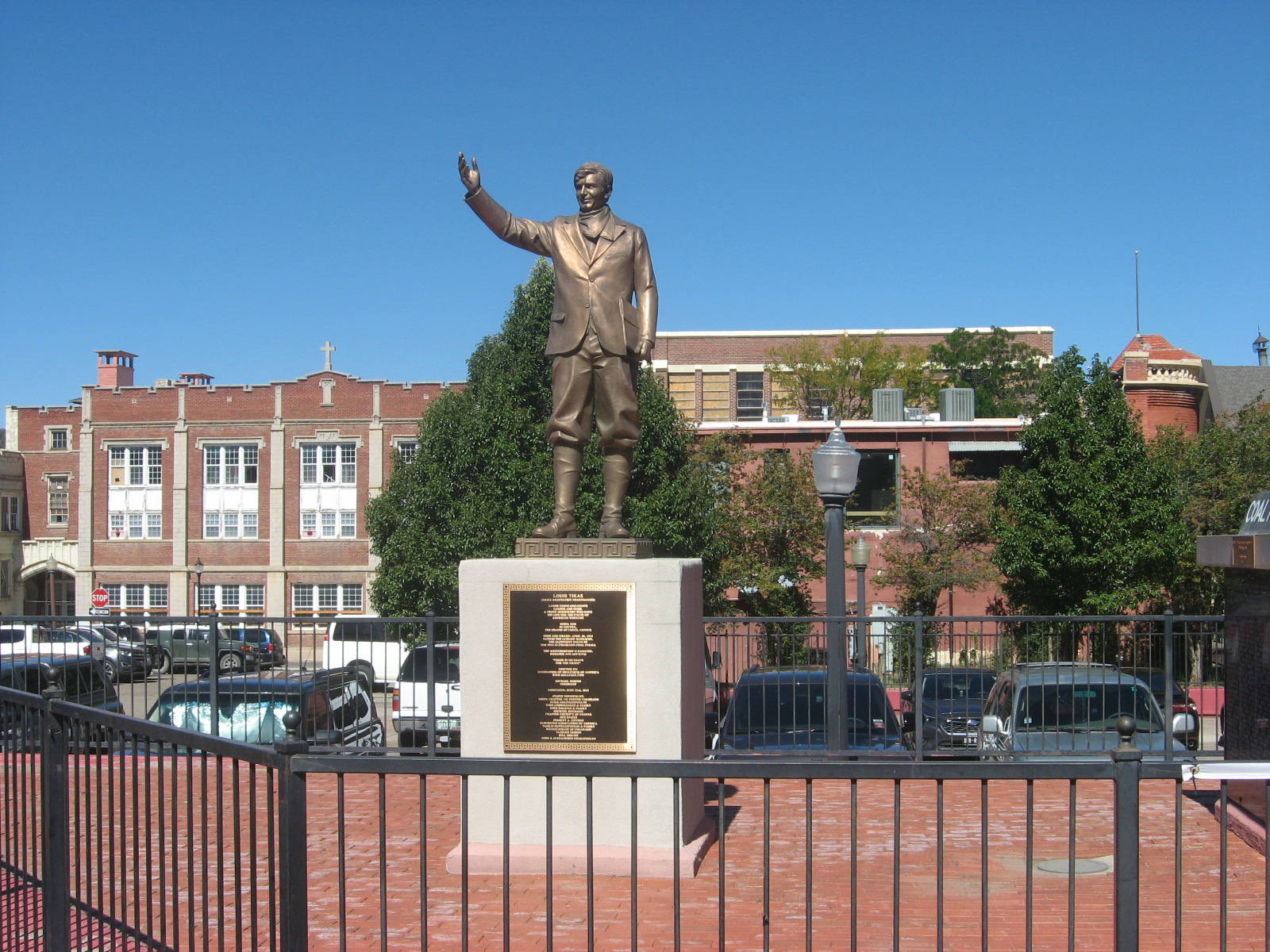
Picture 10 – Is a picture to the left of the Miners Memorial of the statue of Greek miner and tent camp leader Louis Tikas, assassinated by National Guard troops toward the end of the Ludlow Massacre. All those who died are listed on the back of the monument at Ludlow. I list them in order from top to bottom: Louis Tikas, Age 30 Yrs; James Fyler, Age 43 Yrs; John Bartolotti, Age 45 Yrs; Charlie Costa, Age 31Yrs; Fedelina Costa, Age 27 Yrs; Onafrio Costa, Age 6 Yrs; Lucy Costa, Age 4 Yrs; Frank Rubino, Age 23 Yrs; Patria Valdez, Age 37 Yrs; Eulala Valdez, Age 8 Yrs; Mary Valdez, Age 7 Yrs; Elvira Valdez, Age 3 Mo; Joe Petrucci Age 4 ½ Yrs; Lucy Petrucci, Age 2 ½Yrs; Frank Petrucci, Age 6 Mo; William Snyder Jr, Age 11 Yrs; Rodgerlo Pedregone, Age 6 Yrs; Cloriva Pedregone, Age 4 Yrs.


Sunday, November 3, 2024

Arthur Schlesinger Jr’s, A Thousand Days, - A Comment

Arthur Schlesinger Jr’s, A Thousand Days, - A Comment

In Arthur Schlesinger’s memoir of his years as an advisor to President John F. Kennedy, A Thousand Days, he wrote about the right wing as he saw them in 1965, the year of publication. You might get a sense of Déjà vu.

From page 750:

“The burst of right-wing activity in the early sixties was a predictable historical phenomenon. In conservative periods, like the fifties, the radical right was characteristically disorganized and dormant. Its members were soothed by the eternal hope that a conservative administration might do something they would like.” . . .
“But the election of a progressive administration generally has a galvanizing effect on the radical right. It grows desperate, convinced that the nation is in mortal danger, that it is five minutes before midnight, that it must rally and resist before it is too late.” . . .

He went on with “I first heard of the John Birch Society in an early warning letter of December 1960 from that fine old progressive Republican Alfred M. Landon. One heard a great deal more of it in the months following. The radical right appealed equally to the incoherent resentment of the frightened rich and the anxious middle class. It flourished particularly in states like California and Texas, overflowing over raw new money; in states like Arizona and Florida, where older people had retired on their pensions; in small towns in the mountain states, where shop keepers felt harassed by big business, big labor, and big government. The mood is one of longing for a dreamworld of no communism, no overseas entanglements, no United Nations, no federal government, no labor unions, no Negroes or foreigners – a world in which Chief Justice Earl Warren would be impeached, Cuba invaded, the graduated income tax repealed, the fluoridation of water stopped and the import of Polish hams forbidden.”

Remember this was written in 1965